The Manticore Project
Why Field-Level Inference?
The large-scale structure of the Universe — the web of dark matter filaments, clusters, and voids that stretches across billions of light-years — is shaped by the initial conditions set in the earliest moments after the Big Bang. Traditional cosmological simulations start from random initial conditions and produce statistically representative but fictional universes. They can tell us what a universe like ours should look like on average, but they cannot tell us about the specific structures in our own cosmic neighbourhood.
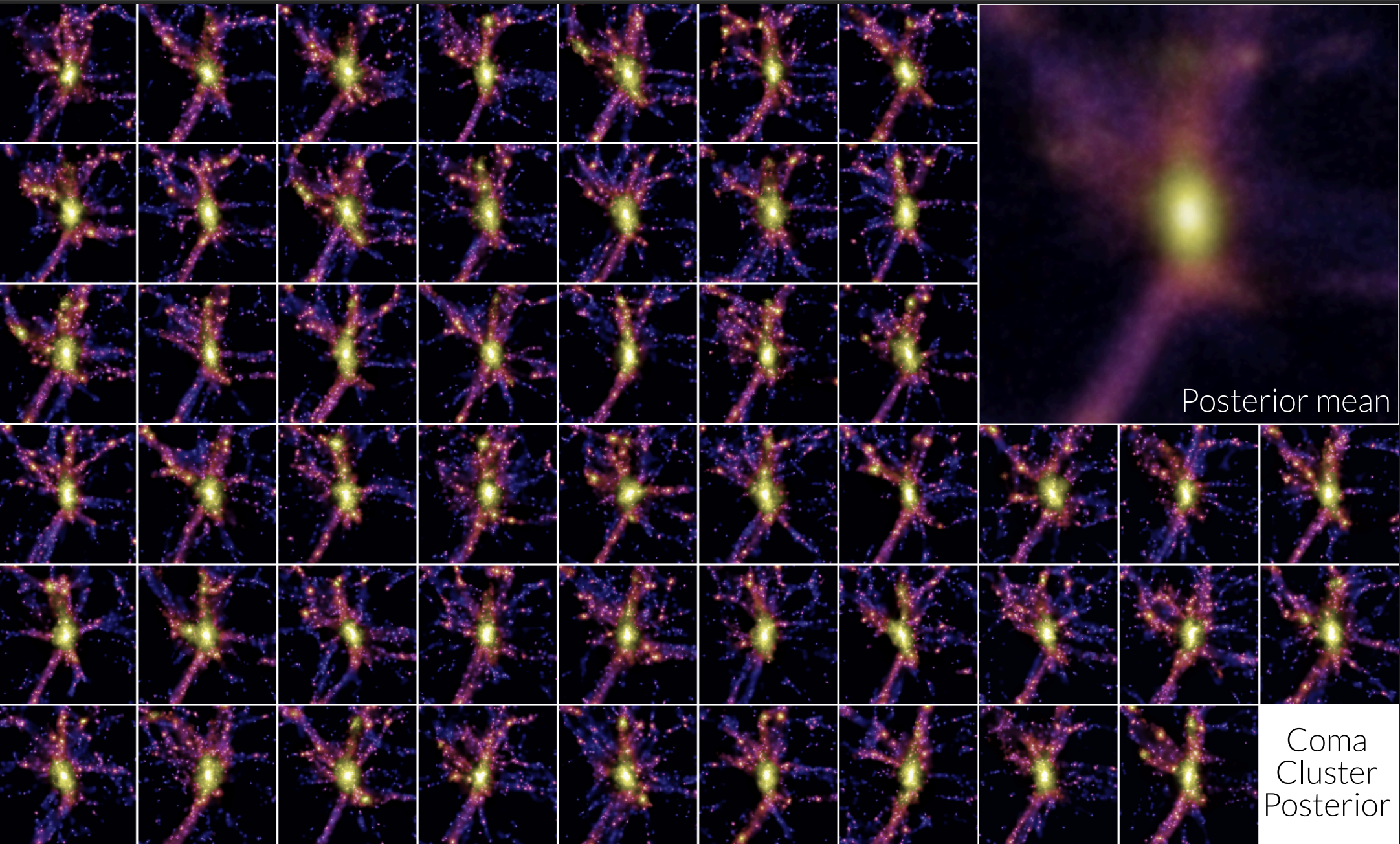
Manticore takes the opposite approach. Using Bayesian field-level inference, we work backwards from real observations — galaxy redshift surveys such as 2M++, SDSS, and BOSS — to infer the initial conditions that evolved into the Universe we actually observe. The result is not a single best-guess model, but a full posterior ensemble of possible cosmic histories: dozens of independent realisations that each reproduce the observed galaxy distribution while capturing the uncertainties in both the data and the theory.
This is a fundamentally different kind of simulation. Each Manticore realisation is a complete, physically self-consistent universe — with dark-matter density fields, velocity fields, galaxy clusters, and cosmic voids — constrained to match the real sky. This allows us to ask questions that no unconstrained simulation can answer: what is the mass of the Coma cluster? How fast is the Local Group moving, and why? Where are the voids in our neighbourhood, and how significant are they?
How It Works
At the core of Manticore is the BORG algorithm (Bayesian Origin Reconstruction from Galaxies). BORG fits a physical structure formation model — including a nonlinear gravitational solver, a refined galaxy bias model, and physics-informed priors — directly to the observed galaxy catalogue. It uses Hamiltonian Monte Carlo sampling on a 3D density grid to produce posterior distributions over the initial conditions of the Universe.
These inferred initial conditions are then evolved forward using the SWIFT N-body simulation code to produce constrained dark-matter realisations of the nearby Universe. Structure identification is performed using HBT+ for halos and VIDE for cosmic voids, applied independently to every realisation in the ensemble. Because the same structures appear across realisations — but with natural variation — we can assign rigorous Bayesian uncertainties to every property we measure.

What Can We Learn?
Because Manticore reconstructions are complete physical models of our local Universe, they can be compared against observations in ways that go far beyond the input data. Several studies have already demonstrated the scientific reach of this approach:
Measuring the Hubble Constant
At low redshifts, the peculiar velocities of galaxies — their motions on top of the Hubble flow — are a dominant source of systematic error in measurements of the expansion rate, H0. Manticore's posterior velocity field provides a principled correction for these motions, with uncertainties that propagate naturally into the final result. Applied to Cepheid distance-ladder data, using Manticore velocities over linear reconstructions yields a ~20% reduction in uncertainty on H0 (Stiskalek et al. 2025).
Mapping Clusters and Their Histories
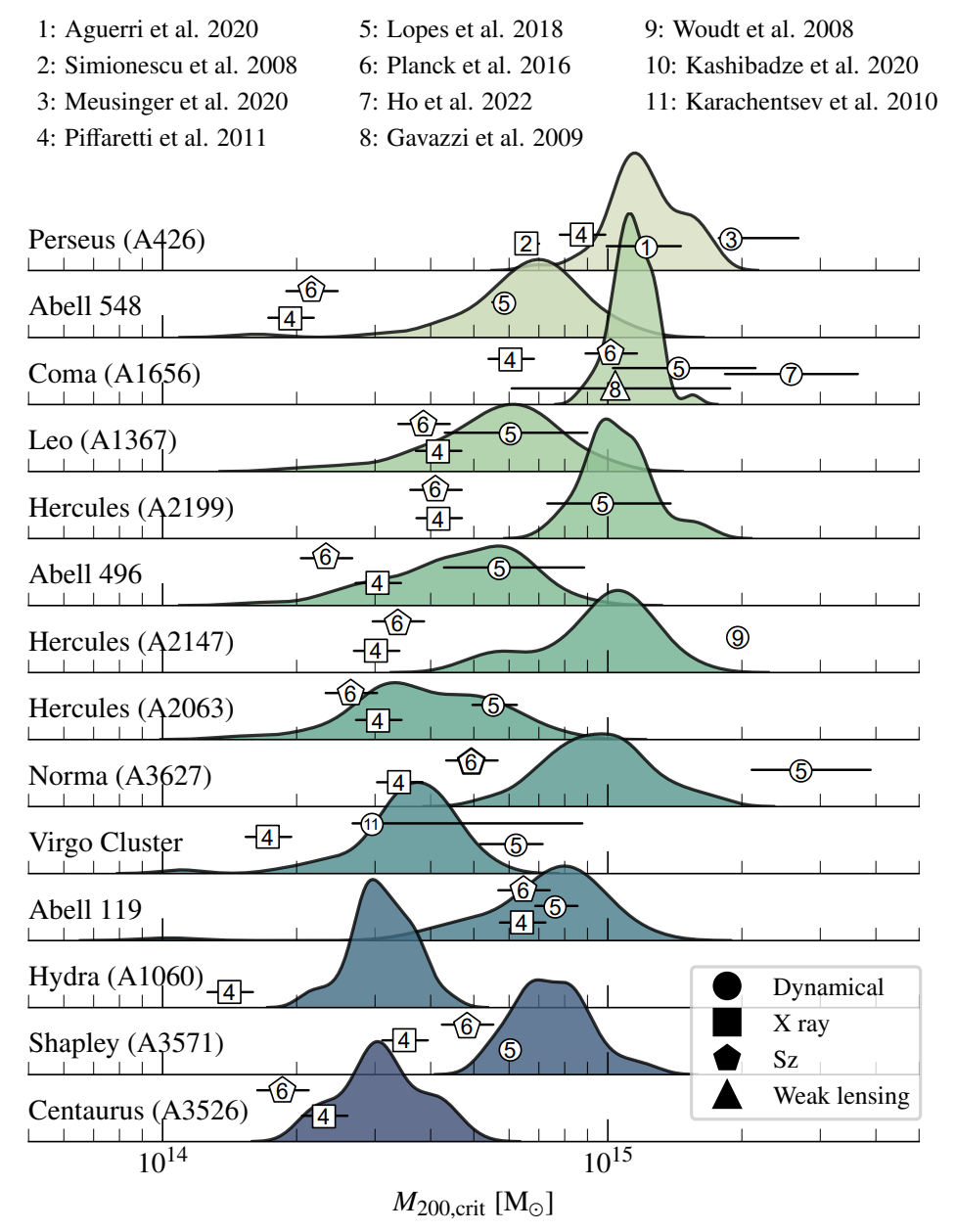
The Manticore-Local cluster catalogue identifies 225 massive structures across the posterior ensemble, each with full probability distributions on mass, position, and velocity. Because the simulations evolve from initial conditions, they also constrain the formation histories of these clusters — their progenitor configurations are localised to volumes 2–5 times smaller than in unconstrained simulations. Independent validation against Planck thermal Sunyaev-Zel'dovich observations and weak-lensing-calibrated eROSITA masses confirms the catalogue's accuracy (McAlpine 2025).
Charting Cosmic Flows
The reconstructed velocity field has the highest Bayesian evidence across five independent peculiar velocity datasets, surpassing all competing methods (McAlpine et al. 2025). This velocity field has been used to revisit the nature of the Great Attractor — showing that it is not a single dominant structure but an artefact of the instantaneous velocity field — and to trace the Local Group's dynamical trajectory into the far future (Stiskalek et al. 2026).
Discovering Voids with Rigorous Significance
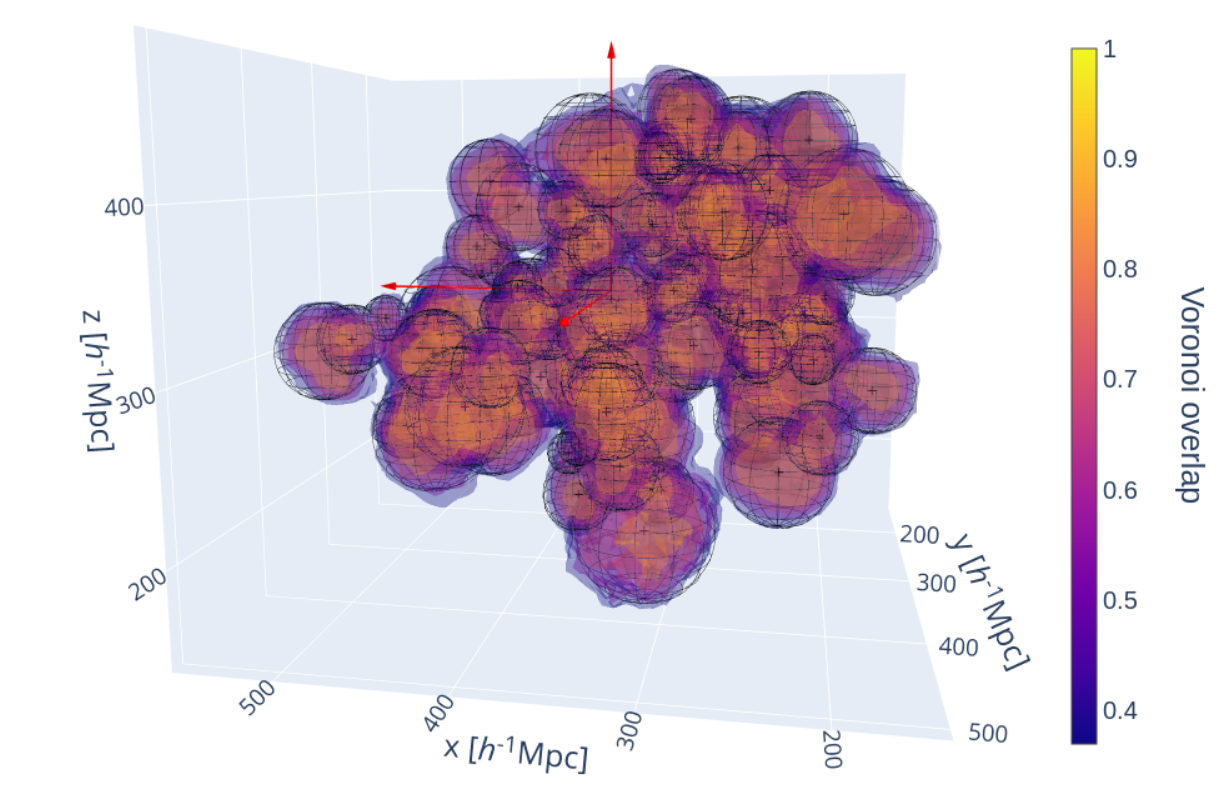
Cosmic voids are powerful cosmological probes but notoriously difficult to detect robustly, because observational artefacts can easily mimic or obscure them. By running void finders across the full posterior ensemble, the Manticore framework naturally marginalises over these systematics, producing a catalogue of 100 voids at 5-sigma significance — the first Bayesian void catalogue of its kind (Malandrino et al. 2025).
Testing the Standard Model of Cosmology
By comparing the reconstructions directly against independent observations — from thermal SZ maps to X-ray cluster scaling relations — Manticore provides stringent field-level tests of ΛCDM. Recent work has used the reconstructions to test for cosmic anisotropy in the local expansion rate, finding no significant deviations and demonstrating that previous claims of anisotropy were artefacts of inadequate velocity modelling (Yasin et al. 2026).
Inference Suites
The Manticore Project builds its data products from a set of core Bayesian inferences. Each applies the field-level methodology to different observational datasets and at different resolutions.
| Inference Name | Box Size (Mpc/h) | Grid Resolution | Cosmology | Num Samples |
|---|---|---|---|---|
All data products — density fields, velocity fields, cluster and void catalogues — are publicly available via the Data Access page.